
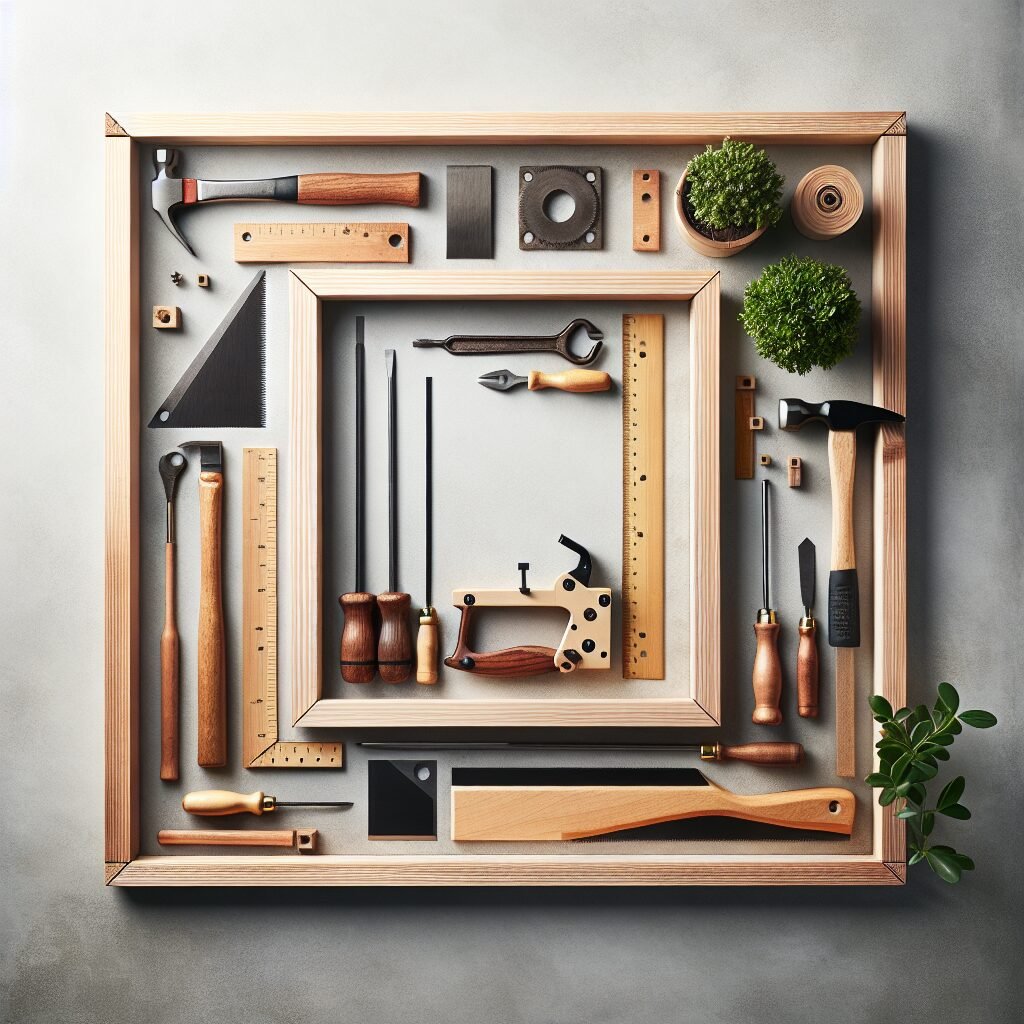
Woodworking can be a fulfilling hobby or a productive profession, but it often comes with the misconception that you need a large workshop and a hefty budget to get started. Fortunately, with the right approach, you can create beautiful projects even in a small space and on a limited budget. By choosing essential tools wisely, you can maximize your efficiency and creativity without overwhelming your workspace or finances.
The essential woodworking tools for a small shop on a budget are a circular saw or hand saw, a cordless drill, a random orbit sander, four clamps, a combination square, a tape measure and a block plane. That set builds real furniture. Everything beyond it solves speed and repeatability, not capability.
- Seven tools will build real furniture. Buy those first and stop.
- Space and budget pull opposite ways: compact costs more, cheap takes more room.
- A circular saw with a straightedge does most of what a table saw does, slower.
- Save on: clamps, mallets, sawhorses, layout tools, secondhand machines.
- Do not save on: anything with an edge you must sharpen, or anything protecting your body.
- A wall is storage. Floor space is the thing you are short of.
- Hand tools are the apartment answer, mostly because of noise.
The Two Constraints Pull in Opposite Directions
In short: the space-efficient tool is usually expensive, and the cheap tool is usually big.
Worth saying plainly up front, because most tool lists quietly assume you are short of only one.
A track saw takes up almost no room and replaces a table saw for sheet goods. It also costs more than a used contractor saw. A used cast-iron table saw off a local listing may cost a fraction as much and needs several square metres with infeed and outfeed clearance.
Same tension across the board:
| Job | Space-efficient answer | Budget answer |
|---|---|---|
| Ripping sheet goods | Track saw | Circular saw and a straightedge |
| Thicknessing | Benchtop planer | Hand plane, or buy S4S lumber |
| Flattening | Planer sled | Hand planes |
| Joinery | Router and jig | Hand saw and chisel |
| Sanding | Random orbit sander | Sanding block |
| Workholding | Folding bench | Heavy shop-built bench |
Notice the pattern in the right column: hand tools are the budget answer and often also the space answer. They are cheap, silent, storable on a wall, and slow. If both constraints bite hard, you are being pushed toward hand tools whether you intended it or not, and that is a legitimate way to work rather than a consolation prize. See hand tools vs power tools.
The exception is anything requiring an edge. A cheap chisel is a bad chisel, because it will not hold an edge and you will spend your time sharpening rather than working.
Buy Tools in This Order
In short: seven tools first, then add only when a project actually stalls.
| # | Tool | Why here | Skip if |
|---|---|---|---|
| 1 | Circular saw, or a good hand saw | Nothing happens until you can break down stock | You have a track saw |
| 2 | Cordless drill/driver | Every project uses it | Never |
| 3 | Clamps, at least four | You cannot glue up without them, and everyone owns too few | Never |
| 4 | Combination square | Accuracy starts here. Cheap and permanent | Never |
| 5 | Tape measure | Every cut starts with a measurement, and the second one is never wasted | Never |
| 6 | Random orbit sander | Turns acceptable work into finished work | You enjoy hand sanding |
| 7 | Block plane | Trims, chamfers, fits joints, cleans end grain | Never |
That is the whole starting kit, and it will build the projects in our free plans.
Then add, in the order your projects stall:
- Chisels, a small set. Buy decent ones, learn to sharpen.
- Jigsaw for curves, or a band saw if space allows.
- Trim router. Small, cheap, does most of what a full router does.
- Miter saw or a bench hook and back saw for repeatable crosscuts.
- Hand planes, a No. 4 smoothing plane first.
- Track saw or table saw, when sheet goods become routine.
The rule: do not buy tool 10 because a list said so. Buy it when a project has actually stopped because you do not have it. Tools bought speculatively become storage problems, which in a small shop is the exact cost you cannot afford.
When it comes to woodworking, not all tools are created equal. Selecting the right tools can make a significant difference in your woodworking experience, especially in limited spaces. Focus on multi-functional tools that serve various purposes to save both space and money. For instance, a good quality combination square can help you measure, mark, and check for squareness all in one tool.
Additionally, consider investing in tools that are easy to store and transport. Compact tools, like a mini circular saw or a folding workbench, can fit into smaller areas while still allowing you to tackle a variety of projects. This way, you can maintain an organized workspace without sacrificing functionality.
When it comes to woodworking, the choice of tools can significantly impact your experience and results. For those working in compact environments, it's essential to select tools that are versatile and space-efficient. A combination of hand tools and power tools can provide the flexibility needed to tackle various tasks while maintaining a minimal footprint. For instance, a quality hand tool set can complement power tools, offering both precision and control, especially in tight spaces.
Investing in a compact workbench is also crucial. A sturdy work surface allows you to work comfortably while keeping your tools organized. Many workbenches are designed to fold or collapse, making them ideal for small workshops. Additionally, consider incorporating tool storage solutions that maximize vertical space, such as pegboards or wall-mounted racks, to keep your workspace tidy and functional.
Essential Hand Tools
In short: hand tools are cheap, silent, wall-storable and slow. In a small budget shop that trade is usually worth it.
| Tool | Does | Buy quality? |
|---|---|---|
| Combination square | Marking, checking square, setting depth | Yes. An inaccurate square poisons everything |
| Tape measure | Rough measuring | No |
| Marking knife | Precise layout lines | Cheap, big accuracy gain over a pencil |
| Marking gauge | Repeatable lines parallel to an edge | Mid |
| Hand saw, crosscut and rip | Breaking down stock | Mid. Modern hardpoint saws are cheap and cut well |
| Back saw | Joinery cuts | Yes |
| Chisels, 1/4 to 1 inch | Joinery, paring, cleanup | Yes. Edge holding is the whole point |
| Block plane | Chamfers, end grain, fitting | Yes |
| No. 4 smoothing plane | Surfacing, removing machine marks | Secondhand and refurbished is the value route |
| Mallet | Chisel work | No. Make one |
| Clamps | Everything | No. Buy quantity over quality |
| Bench hook | Safe hand crosscuts | Make it, from offcuts |
| Shooting board | Trimming end grain square | Make it |
The two shop-made items at the bottom cost nothing and do more for accuracy than most purchases. A bench hook makes hand crosscutting safe and repeatable; a shooting board makes end grain square in a way that is difficult to achieve freehand.
Hand tools are indispensable for any woodworker, especially when working in confined spaces. Here are some must-have hand tools that won't break the bank:
- Hand saw: A quality hand saw is versatile and can be used for various cuts.
- Chisels: A set of sharp chisels is essential for detailed work and joinery.
- Clamps: Having a few clamps on hand is crucial for holding pieces together while glue dries.
- Woodworking plane: A plane helps you achieve smooth surfaces and precise thicknesses.
These tools are not only affordable but also easy to store. You can keep them in a toolbox or even hang them on a wall to save space. woodworking workspace organization.
Hand tools are often more affordable than their power counterparts and require less space for storage and operation. A few key hand tools can cover a wide range of tasks, making them perfect for small-scale woodworking. A good-quality hand saw, for instance, can handle most cutting tasks without the need for bulky equipment. Similarly, a set of chisels is invaluable for detailed work, allowing for precise cuts and adjustments.
Another essential hand tool is the block plane, which is perfect for smoothing edges and surfaces. It’s compact and easy to use, making it ideal for smaller projects. Furthermore, having a reliable measuring tape and square will ensure accuracy in your woodworking endeavors. These tools are not only affordable but also easy to store, making them perfect for those with limited space.
For those looking to expand their skills, taking the time to learn woodworking skills can be incredibly beneficial. Online classes can provide guidance on how to effectively use these tools, enhancing your overall woodworking experience. Embracing both hand tools and learning opportunities will empower you to tackle more complex projects as your confidence grows.
Creating a functional workshop in a small space on a budget may seem daunting, but with the right tools, it can be an enjoyable endeavor. Essential woodworking tools not only help you complete projects efficiently but also enhance your skills over time. As you curate your collection, it’s important to focus on versatility, quality, and compactness to ensure that your workspace remains organized and productive.
Hand tools are a cornerstone of woodworking, especially in small spaces where power tools may take up too much room. A reliable set of hand tools can provide you with everything you need to get started. Look for a good quality hand saw, chisels, a reliable hammer, and a combination square. These tools are not only essential for a variety of tasks but also easy to store and maintain.
Additionally, investing in a set of clamps is crucial for any woodworking project. Clamps help you hold pieces together securely while you work, ensuring precision and stability. They come in various sizes and styles, allowing you to choose the ones that fit your projects best. If you're looking woodworking for beginners to find tips on selecting tools that suit your needs.
Power Tools Worth the Space
In short: corded is cheaper, cordless is more convenient, and benchtop beats floor-standing when the floor is the constraint.
| Tool | Space cost | Verdict |
|---|---|---|
| Cordless drill/driver | Negligible | Essential |
| Random orbit sander | Negligible | Essential |
| Jigsaw | Negligible | Buy early, does curves badly but does them |
| Trim router | Small | High value per cubic inch |
| Circular saw | Small | With a straightedge, replaces a table saw for most cuts |
| Track saw | Small | Best small-shop sheet-goods answer, costs more |
| Miter saw | Medium, needs infeed and outfeed | Skip early. A bench hook does crosscuts |
| Benchtop planer | Medium, stores on a shelf | Buy when lumber cost matters |
| Band saw | Medium footprint, small envelope | The best floor-standing machine for a small shop |
| Table saw | Large, needs clearance all round | Last, if at all |
| Benchtop jointer | Medium | Skip. Planer and sled, or hand planes |
Corded versus cordless. Corded tools are cheaper for the same power and never need a battery. In a small shop where everything is within a few feet of an outlet, the cord is barely a cost. If you already own a battery platform, stay on it; if you do not, corded saves real money.
More on the machines themselves in woodworking machinery.
While hand tools are crucial, power tools can significantly enhance your woodworking capabilities. However, you should choose wisely to ensure you are not overcrowding your workspace. A compact router is a fantastic addition that allows you to create decorative edges and hollow out areas in wood with ease.
Another great tool is a jigsaw, which is perfect for making intricate cuts without taking up much space. When selecting power tools, consider their size and weight, as well as their versatility. You’ll find that many tools can perform multiple functions, helping you maintain a clutter-free environment.
To stay within budget, explore options for purchasing used tools or budget-friendly woodworking resources that can guide you in finding quality tools at a lower cost.
Creating a functional woodworking space in a small area on a budget can be a rewarding challenge. With the right selection of tools, it's possible to craft beautiful projects without needing a full workshop. In this segment, we will explore essential woodworking tools that are perfect for both small spaces and budget-conscious makers.
While hand tools are essential, having a few compact power tools can significantly enhance your woodworking capabilities. A small jigsaw is a great addition; it allows for intricate cuts and is easy to maneuver in tight spaces. Additionally, a cordless drill can save you time and effort, making it easier to drive screws and create holes without the hassle of cords getting in the way.
Another power tool worth considering is a compact router. This tool can add decorative edges to your projects and create joints with precision. When choosing power tools, opt for models that are lightweight and easy to store, ensuring they won't take up too much valuable workshop space. By carefully selecting your tools, you can maximize your efficiency without compromising on quality.
Woodworking Without a Table Saw
In short: a circular saw with a straightedge, plus a bench hook, covers most of it.
The table saw is the assumed centre of most shops and it is the single hardest machine to fit into a small one, because it needs clear space on all four sides, not only its own footprint.
What replaces it:
- Ripping and breaking down sheets: circular saw against a clamped straightedge, or a shop-made saw guide. A track saw is the refined version.
- Repeatable crosscuts: miter saw, or a bench hook and a back saw, or a crosscut sled on a track saw.
- Narrow rips: band saw, or a hand rip saw.
- Dados and grooves: router with an edge guide.
- Tenons and joinery: back saw and chisel, or a router jig.
What you genuinely lose: speed and repeatability on identical parts. If you are making one bookcase, a circular saw and a straightedge cost you time. If you are making twelve, the table saw earns its space.
And you gain something: a circular saw stores on a shelf, makes less noise, and does not need four metres of clear floor. For a garage that also holds a car, that is often decisive.
Where to Save and Where Not To
In short: save on anything you can make or that has no edge. Do not save on edges or safety.
Save on:
- Clamps. Buy cheap and buy many. Quantity matters far more than quality for most glue-ups.
- Mallets, bench hooks, shooting boards, sawhorses, push sticks. Make them from offcuts.
- Tape measures, pencils, sanding blocks. No meaningful quality difference.
- Machines, bought secondhand. See below.
- Workbench. Build it. See choosing a woodworking bench.
Do not save on:
- Chisels and plane irons. Cheap steel does not hold an edge, so you sharpen constantly and cut badly in between. This is the most common false economy in woodworking.
- Your combination square. If it is not square, every piece of work inherits the error and you will not know why nothing fits.
- Safety equipment. Eye protection, hearing protection, and a NIOSH-approved respirator. OSHA links several hardwood dusts to nasal cancer in woodworkers (OSHA), and this is not the category to economise in. See respirator for woodworking.
- Anything holding a spinning blade. Blade guards, riving knives, secure fences.
A note on cheap stock. Budget shops usually buy softwood, and softwood species vary a lot in how they work, hold a fastener and take a finish. The USDA Forest Products Laboratory Wood Handbook documents the working properties of common species, which is worth a look before you decide that pine “did not work” when the real problem was the particular board.
Middle ground: buy cheap, upgrade what annoys you. Buying the cheapest version of a tool you are unsure you need is reasonable, because using it teaches you what matters. The failure mode is buying cheap versions of everything at once and ending up with a full shop of tools that all slightly do not work.
Broader cost strategy in budget-friendly woodworking.
Buying Secondhand
In short: machines and hand planes are excellent secondhand. Anything with a battery or an unknown edge is not.
Good secondhand: cast-iron machines, hand planes, chisels, clamps, marking tools, cast-iron bodied anything. Older machines were often built heavier than current equivalents at the same price point.
Bad secondhand: cordless tools with used batteries, since batteries are most of the value and degrade invisibly. Anything with a cracked casing. Machines missing guards, because replacements are expensive and hard to source, and running without them is not an option.
What to check on a used machine:
- Bearings. Spin it by hand and listen. Rumble means a rebuild.
- Table flatness. Straightedge across it in both directions and diagonally.
- Fence. Does it lock parallel and stay there? A bad fence ruins a good saw.
- Rust. Surface rust cleans up. Pitting on a table does not.
- Guards present. Riving knife, blade guard, pawls.
- Power. Confirm the voltage it needs before you buy.
On rusty hand planes: a rusty plane with a flat sole and an intact iron is usually a good buy. Rust cleans off; a cracked casting or a warped sole does not.
Storage and Layout
In a small workshop, organization is key. To keep your tools accessible yet out of the way, consider wall-mounted storage solutions. Pegboards can be an excellent way to hang tools, keeping them visible and easy to reach. You can also invest in rolling tool carts or stackable storage bins to make the most of your limited space.
Another effective storage method is using drawer organizers for your hand tools. This will not only save space but also help you maintain a tidy workspace. Remember, a clutter-free environment can lead to increased focus and productivity, which is essential for any woodworking project.
Think in walls, not floor. Floor space is what you are short of. A French cleat wall takes almost no depth, reconfigures freely, and holds most hand tools within reach of the bench.
Everything on wheels. Any machine on a mobile base can be pulled out for use and pushed against a wall after. This roughly doubles a small shop's usable area. Locking casters, and prefer bases that let the machine sit on its own feet when down.
Store at point of use. Chisels near the bench, drill bits near the drill press. In a small shop the cost of walking somewhere for a tool is that you stop using it.
One flat surface, protected. The fastest way to lose a small shop is to let the bench become storage. Keep one surface clear.
More in organizing your woodworking workspace and creating a harmonious workspace.
Noise, Dust and Neighbours
In short: hand tools are quiet, dust extraction is not optional indoors, and both matter more in a shared building.
Rarely covered and often the actual constraint for anyone working in an apartment, a shared garage or a house with sleeping children.
Noise. A planer or router is loud enough to be a genuine neighbour problem. Hand tools are close to silent, which is a real argument for the hand tool route beyond cost and space. If you must use machines, restrict them to a window of the day and do the hand work at other times. A benchtop planer is the machine most small shops add first, and it brings one quirk worth understanding before you mill a stack of boards: see planer snipe and how to fix it.
Vibration travels through a building's structure more than people expect. A machine on a mobile base with rubber-tyred casters transmits less than one bolted to the floor.
Dust indoors is the serious one. In a small enclosed space, dust concentration climbs faster than in a large workshop with the same tool. Extraction at the tool, an ambient air filter, and a respirator for sanding. OSHA's woodworking eTool gives the occupational limits for scale: the nuisance-dust PEL is 15 mg/m³ total with NIOSH recommending 1 mg/m³ (OSHA).
Finishing indoors needs ventilation, and some finishes should not be used in a living space at all. Water-based finishes are the low-odour route.
For the fuller picture on what dust does over time, OSHA's sawmills health hazards guidance covers the same wood dust exposures in an industrial setting, where the effects were first documented.
Small Shop Tools FAQ
What are the absolute essential woodworking tools?
A saw, a drill, clamps, a combination square, a tape measure, a sander and a block plane. Seven tools that will build real furniture.
Can I do woodworking in an apartment?
Yes, mostly with hand tools. Noise and dust are the constraints rather than space. Hand tools are quiet, produce shavings rather than airborne dust, and store on a wall.
Do I need a table saw?
No. A circular saw with a straightedge does most of the same cuts more slowly. The table saw buys speed and repeatability, and it is the hardest machine to fit into a small shop.
What is the best budget saw for a beginner?
A corded circular saw with a shop-made straightedge guide. It breaks down sheets, rips and crosscuts, costs little and stores on a shelf.
Should I buy hand tools or power tools first?
Buy the drill and a saw whichever route you take. After that, hand tools if budget and noise are your constraints, power tools if time is.
Is it worth buying cheap chisels?
No. This is the clearest false economy in woodworking. Cheap steel will not hold an edge, so you sharpen constantly and cut poorly in between. Buy a small set of decent ones instead of a large set of bad ones.
How much space do I need for woodworking?
Less than most people assume. A bench, a wall for storage and somewhere to break down sheet goods. Hand tool woodworking fits in a corner of a room. Machines are what demand area, mostly for infeed and outfeed clearance rather than footprint.
Is secondhand machinery a good idea?
Often yes, particularly older cast-iron machines. Check bearings, table flatness, the fence, and that all guards are present, since missing guards are common and expensive to replace.
What should I make first?
Something small, useful and forgiving. See free woodworking plans for six beginner projects with cut lists.
How do I keep dust down in a small shop?
Extraction at the tool, an ambient air filter, and a respirator for sanding. In a small enclosed space dust concentration rises faster than in a large one, so it matters more, not less.
Want the complete plans and step-by-step training?
Get instant access to thousands of detailed woodworking projects.
Join The Training